Female Science Talents, a new platform for African women in science


African women researchers. Episode 4. Female Science Talents was launched in 2022 as a part of the Falling Walls Foundation’s mission to promote female leadership and enhance the global recognition of “exceptional” women in science.
The initiative based in Germany offers a year-long Intensive Track for 20 women selected around the world and across all scientific disciplines. It provides close mentorship, intensive training, and networking opportunities with high-profile leaders.
”By increasing the visibility of female scientists and providing structured support, the program aims to help participants achieve significant career breakthroughs within a year,” said Julia Milbredt, head of programme at Female Science Talents. “Participants are given a platform at the annual Falling Walls Science Summit and Berlin Science Week to share their work and expand their networks internationally.”
Introduction of our Series
Female Science Talents also addresses challenges faced by women in science, particularly in making transition from academia to industry and leadership roles. Participants are matched with mentors, engage in peer learning and coaching, and are encouraged to develop their own leadership strategies through workshops and online training.
According to the organisation’s survey, 50% of the participants advanced in their careers, including promotions to group leader, senior researcher, or assistant professor positions. 68,97% highlight the strong peer support during the programme which includes the factor of empowerment and a better awareness of talents and skills, combined with increased self-confidence, subsequently leading to clear career as well as competitive goals.
Every year hundreds of women apply for the program and among them, many are from African countries such as Cameroon, Kenya, Senegal, Tanzania, Ghana and Nigeria. In their current cohort (2024-2025), Africa is even the highest represented continent with seven participants. For Agripreneurs d’Afrique, Julia Milbredt explained how this program has helped to create a new platform for African women in science.
According to Unesco, women account for around 30% of researchers globally. This percentage is even less in many countries in Africa. What is the problem?
As far as I’ve heard, the number significantly increases, the higher the degree and career level gets. This is the case at least here in Germany. While at Master level, the amount of female scientists might be relatively even compared to male, this shifts when looking at PhD or Post-doc level.
From what I’ve read, it comes down to the common factors: the role assumption of women in many countries, where they still take over the majority of caring and household responsibilities or are at least expected to do so (role and gender clichés) and, hence, have to step back from their respective career or at least go on an extended leave, while their career is halted. This is connected to cultural values within a society. What are common norms? How easy is it to break them?
Is it even possible to provide access to education equally despite one’s gender? This gap might be even bigger in Central African countries, but this is just a guess, since I’m not an expert, I’m afraid. I rather see it as my goal, to at least enable access to a support programme like the Female Science Talents, no matter what your origin is.
Secondly, the science world in itself seems to be quite hierarchical and conservative. There need to better support systems set up in order to encourage and help women to follow their career in science. Thirdly, the pay gap needs to be overtaken. If women are able to receive better wages, they might also be able to advance better and faster. In all, system transformation seems to be the key.
Through Female Science talents you are building a network of women researchers from all over the world. Can you tell us more about this initiative?
The Female Science Talents initiative is a programme by the Falling Walls Foundation, designed to inspire and empower talented women in science to advance their careers and take on leadership roles in science, business, and society. It was launched in 2022. With the Intensive Track, the initiative specifically targets early-career female scientists starting at PhD level, supporting them in navigating career transitions, building international networks, and increasing their visibility in the scientific community and beyond.
Each year, we select 20 Talents from all around the world to take part in the programme for a period of 12 months, which includes 2 in-person gatherings here in Berlin (The International Spring and Fall Gathering, respectively). The rest of the curriculum takes place virtually, where we offer peer-to-peer sessions, career talks and a mentoring component every 4-6 weeks.
Episode 1. Professor Francine Ntoumi and the passion for science
What I think makes it special is the fact that we’re trying to create a safe space for the participants, where they can openly exchange on most pressing experiences, such as barriers they are facing, find joint solutions and learn from each other. It is a platform, which ultimately lays the first step to a lifelong network, which is characterised by trust and mutual learning.
We hope that these alliances accompany them for the rest of their lives, encouraging them to reach out to each other for anything related to career advancement, but also more personal topics, like finding a balance between work and motherhood.
We’ve also heard that participants take the opportunity to develop joint research projects and apply for funding, which is another great and practical example. What I think is also unique about the programme is the fact that it is interdisciplinary and diverse. We think it broadens your own horizons to think outside of the box, receive feedback from different people with different backgrounds and perspectives, in addition to the exchange one might have within their own research institution.
Episode 2. In Tanzania, Cesilia Mambile uses AI to predict forest-fire
Since we now have the 4th Batch, we have reached a community of over 80 researchers, in additional to the wider network, consisting of partners, role models and supporters.
Do you receive more candidates from Africa?
We’ve noticed a significant increase of applications from African countries in the past years. My assumption is that the demand is even higher to join such a supporting network. Our alumni seem to be the greatest multipliers, spreading the word about our programme and that is something we appreciate a lot, since we deem it to be extremely beneficial for the programme.
Aside from that, we do have local organisations, which help us to spread our calls, like the Mawazo Institute in Kenya and also the World Academy of Sciences, which has an intrinsic focus on the Global South.
And last but not least, our long-standing partners support us immensely to help us promoting the calls, these are the Elsevier Foundation, the Bayer Foundation, DFG, Volkswagen Foundation and the Klaus Tschira Foundation. They all have access to an international community, which they enable for this purpose.
Episode 3. In Tunisia, Dr Amira Kebir uses mathematics to save lives
For the Intensive Track 2025 (the call took place at the end of 2024), we received 465 applications from 82 countries, among them Zimbabwe, Tanzania, South Africa, Senegal, Nigeria, Ghana, Cameroon and Kenya.
What are you doing to help these women researchers from Africa? Particularly from Central Africa?
Our offers do not vary, we really intend to offer all programme components to everyone.
Are you seeing any evolution with women in science ?
I see that the shifting political context worldwide is asking for increased female leadership and support, more than ever. Especially in these circumstances, it is of utmost importance to form strong communities and alliances to provide a platfrom and visibility to female scientists, as well as entrepreneurs and industry leaders to overcome barriers and existing biases.
Josiane Kouagheu
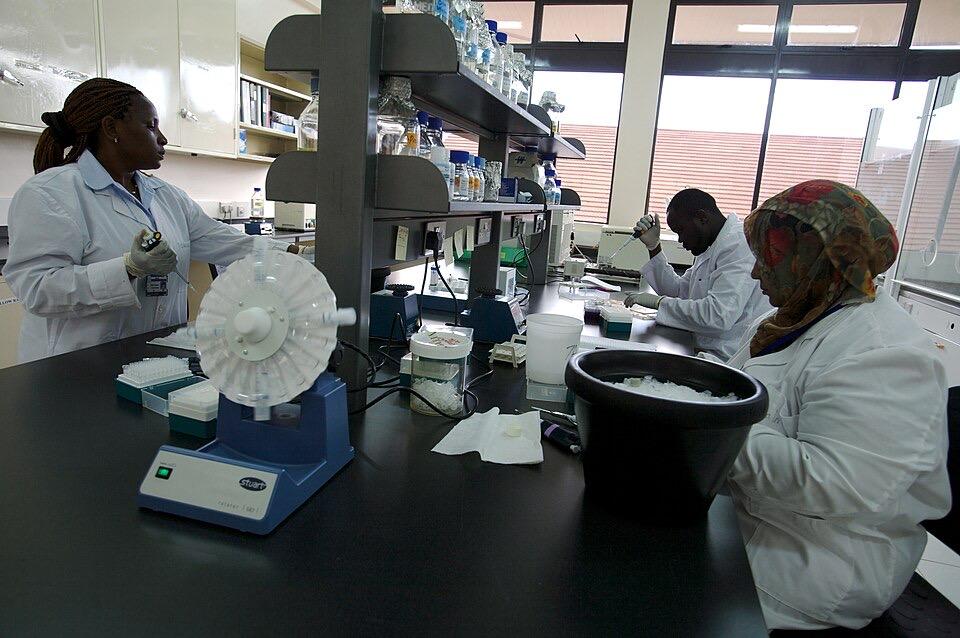
Banner image: researchers working in a Biosafety Level 3 Lab at the university of Cape Town. Image by Robket via Wikimedia Commons.