In west Cameroon, farmers adopt stone barriers, terraces and zaï pits to fight lateritic soils degradation


According to a study, Stone cordons decrease runoff by 50–70 %, while zai pits enhance water retention and soil fertility, leading to a 40 % increase in crop emergence rates during arid periods.
In the West region of Cameroon, lateritic soils are facing more degradation due to their high acidity, low fertility, and susceptibility to erosion. This situation is exacerbated by the effects of climate change.
But many farmers are fighting back in Dschang, a rural town located in the southwestern part of the Bamboutos Mountains. According to a study published in Soil Security, they are using methods such as stone barriers, terraces and hedgerows, organic amendments, and zaï pits to combat the degradation of lateritic soils.
The team of researchers from Cameroon and the Democratic Republic of Congo collected data from 60 farms located in three different topographic positions (hilltops, slopes, lowlands) across 58.8 hectares of the University of Dschang’s land—75 % of the area is cultivated with maize and other staples, 15 % with vegetables, and 10 % with perennial crops.
In total, they conducted 42 interviews in 2024 to address five themes: diagnosis of lateritic soils, perceived climate impacts, adaptation strategies, socio-economic constraints, and local policy interactions.
Additionally, the scientists also conducted laboratory analyses of soils, Soil Adjusted Vegetation Index (SAVI-based remote sensing), satellite image, and an extensive literature synthesis.
“Innovative mineral techniques”
Seventeen soil volumes were delineated, and analyzed concerning agronomic constraints such as compaction, erosion, waterlogging, and acidity, thereby linking intrinsic soil features with challenges reported by farmers.
The team found that in the summit area, characterized by poor soils, a 30 % slope, and boulders, farmers have developed “innovative mineral techniques” like stone cordons, which have a 40 % adoption rate, and mineral mulch, adopted by only 15 % of farmers.
“These methods effectively reduce erosion by 60 %, but their complexity limits widespread adoption,” the study discovered.
The mid-slope area, featuring eroded soils with 10–20 % stones, employs a combination of mineral and plant strategies, specifically stone terraces (25 % adoption) and hedgerows (20 % adoption), resulting in a 50 % reduction in runoff, the scientists wrote.
In the lowlands, which have fertile alluvial soils, organic amendments were favored, with a 42 % uptake leading to a 35 % yield gain, alongside the implementation of drainage systems.
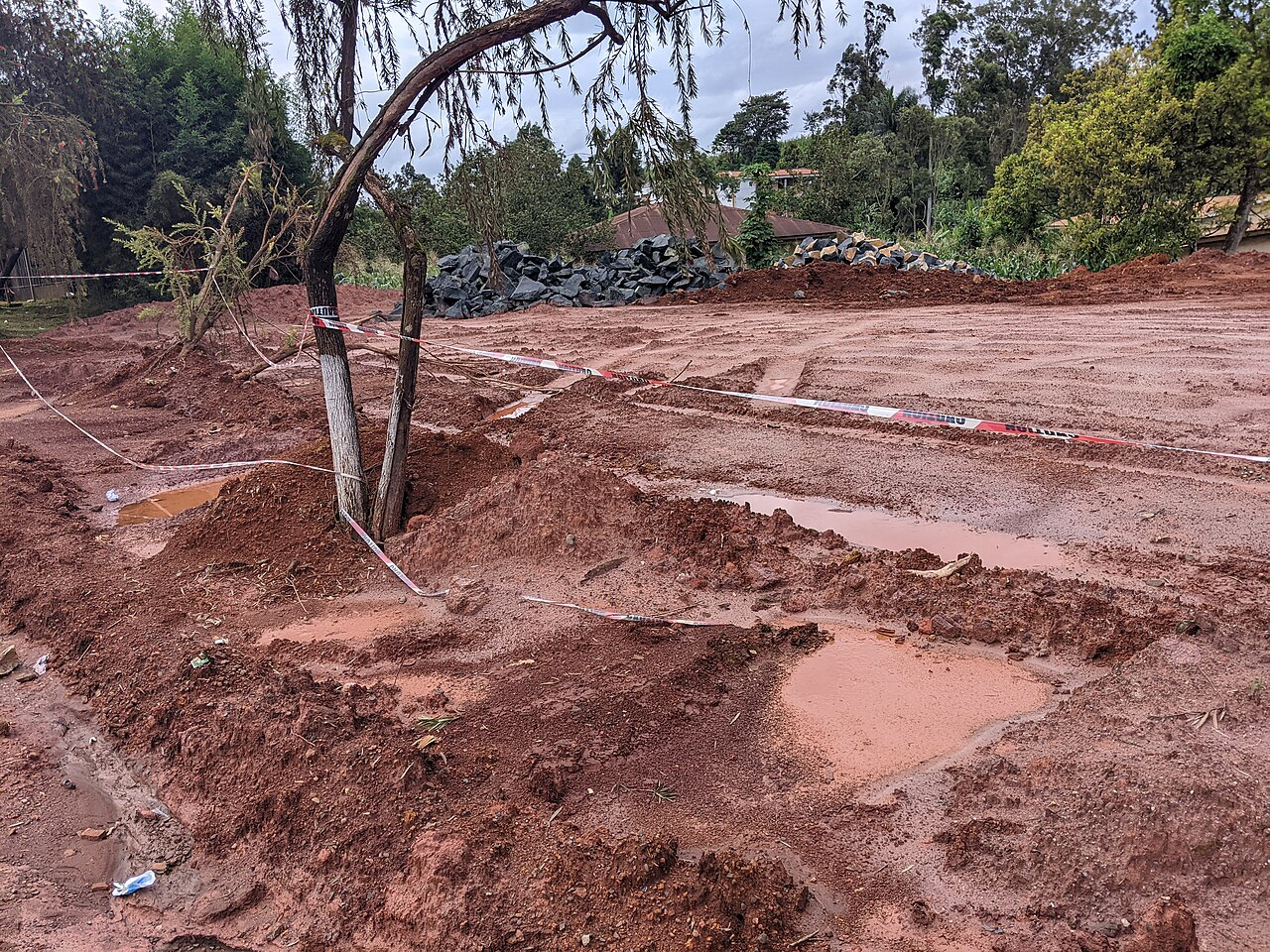
The lateritic soil of Dschang. Photo: Solefackmegane via Wikimedia Commons.
In general, 78 % of the surveyed farmers base their cropping choices on the colour of the soil. They identified three main types of soil: red (‘poor but stable’), yellowish (‘tired’), and black (‘fertile but wet’), a classification that generally corresponds to scientific soil characteristics.
“In the face of erosion and climatic hazards, local techniques such as stone cordons, which reduce runoff by 50–70 %, and zaï ( an agricultural method that consists in digging small holes to retain rainwater), which enhances emergence by 40 % during dry periods, prove remarkably effective,” the team acknowledged.
Zaï
They also noted that techniques combining local knowledge and external inputs (e.g. stone barriers + improved seeds) show the best results (+45 % resilience compared with purely traditional practices).
“However, their adoption remains limited due to material constraints. Paradoxically, certain theoretically suitable solutions like agroforestry are absent from traditional practices, likely because of the precarious status of the cultivated land.”
For instance, the researchers found that Zaï (35 % adoption) is seen as very effective (82 %) but is little used due to a lack of manpower. Moreover, only 25 % of farmers practice mulching despite its acknowledged effectiveness.
For the scientists, the gap between adoption and perceived effectiveness indicates practical constraints. The study also showed that the solution to these challenges are complex.
While 78 % of farmers uphold the Kosmos (acknowledging soil's sacredness) for example, 62 % concurrently adopt a Praxis (chemical fertilization, intensive tillage) that degrades the very entity they hold sacred.
The researchers believe that the transformation of the Kosmos from a passive cultural value into an active institutional and legal asset can change the situation.
“By making secure land tenure ( primary socio-economic constraint) contingent on the adoption of regenerative practices, the contracts aim to re-align economic incentives with sacred values,” they wrote, adding that future research projects can create living laboratories for co-designing adaptive mechanization (e.g., for zaï pits and stone bunds) and conduct participatory cost-benefit analyses that include hidden costs of degradation.
Josiane Kouagheu
Banner image: GKNlend via Wikimedia Commons.