In the North-West region of Cameroon, armed conflict is the primary driver of farmland abandonment

According to a new study, 43 % of surveyed farmers experienced the loss of at least one family member due to the conflict.
In 2016, the Anglophone crisis began in the North-West and South-West regions of Cameroon as peaceful protests over marginalization of teachers and lawyers. The protests were bloodily suppressed and escalated into a war between separatists fighting for the independence of this part of the country and the Cameroonian army.
According to the UN, at least 6 000 people have been killed and more than half a million displaced. Caught in the crossfire, civilians are paying a heavy price.
Farmers have been severely impacted since agriculture is a source of income for 74% of households in the North-West and 53% of those in the South-West ( Fourth Cameroon household survey, 2014).
“Forced to flee their farms”
“The crisis has caused a substantial drop in the production of both subsistence and cash crops,” noted a World Bank report in 2021. “In addition, the overall insecurity generated by the crisis has limited farmers’ mobility and ability to work ... Many rural households have also been forced to flee their farms.”
According to a new study published in Land Use Policy journal, armed conflict is the primary driver of farmland abandonment in the North-West region of Cameroon. The team of scientists surveyed 160 household heads from 32 villages of the region. The average household size was 5.46 individuals.
From the team of researchers.
“The loss of a family member during conflict raised the probability of migration by 79 %,” the researchers wrote. “While perceived environmental stressors are associated with farmland abandonment, their marginal effects are relatively modest compared to conflict-related and migration factors.”
The article defined farmland abandonment as the cessation of agricultural activity in previously cultivated areas, whether temporarily or permanently, and regardless of vegetation recovery.
Conflict dynamics
“Farmland abandonment represents one of the most visible land-use outcomes of armed conflict,” it highlighted. “This occurs through multiple pathways: direct military actions that render land inaccessible, displacement of farming populations, or the perception of insecurity that deters cultivation.”
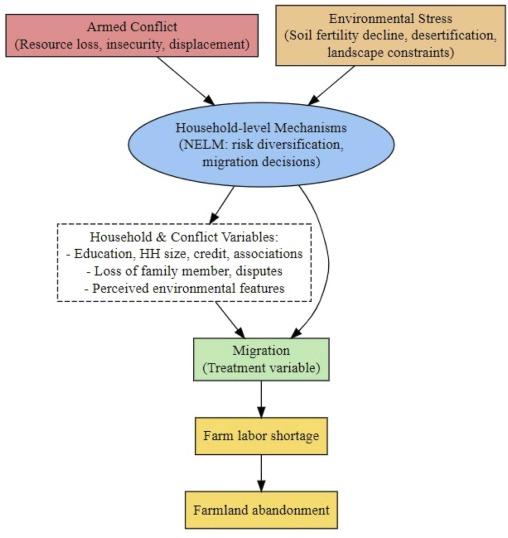
To measure the level and impact of farmland abandonment, the team grounded their study in Political Ecology and the New Economics of Labor Migration (NELM), which together provide a complementary lens for understanding farmland abandonment in conflict-affected settings.
The theory emphasizes that land-use change is not “ merely an ecological or economic process but one embedded in political instability and conflict dynamics” and conceptualizes migration as a household-level risk management strategy, whereby displacement and labor reallocation decisions directly affect agricultural production and land-use continuity
By integrating these perspectives, the research team conceptualized farmland abandonment in Northwest Cameroon as the outcome of intersecting political violence, forced migration, and household adaptation strategies, rather than as a “solely environmentally driven process”.
Decline
They collected data using a structured questionnaire from August to September 2022. The survey was conducted with household heads, including those from families with members who had migrated.
They found that conflict was identified by the majority (approximately 80 %) as the leading factor of farmland abandonment. Moreover, 43 % of the households experienced the loss of at least one family member due to conflict.
From 2015–2021, the researchers noted for example that average cultivated land size remained stable at approximately 4.6 ha. However, there was a sharp decline beginning in 2021, with average cultivated land dropping to 1.98 ha, and further decreasing to 1.64 ha in 2022.
Rebuilding
“The decline in cultivated land after 2021, coinciding with intensifying conflict, suggests that insecurity does not only disrupt immediate farming activities but may also catalyze longer-term shifts in land-use systems,” they discovered. “This trajectory risks entrenching food insecurity and rural economic fragility...”
For them, policies aimed at promoting mechanization or productive investment of remittances are unlikely to be effective without parallel efforts to strengthen local institutions, rebuild community systems, and address insecurity that disrupts labor availability and land use.
“An integrated policy approach that simultaneously tackles these interacting drivers is therefore essential for anchoring households to agriculture and mitigating long-term land abandonment,” the scientists concluded.
Josiane Kouagheu
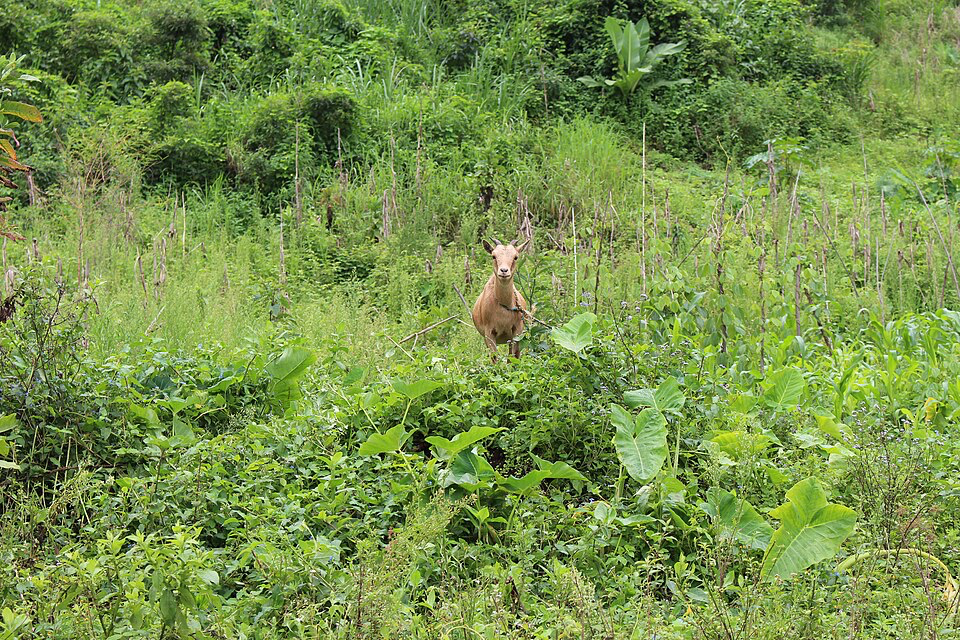
Banner image: a farm located in Boyo Wombong, a village of the North-West region of Cameroon. Photo: Alangi Derick via Wikimedia Commons.