How agricultural commercialization improves women’s diets in Cameroon

According to a new study, women in commercial households located in the West region of the country are likely to consume more nuts, seeds, and vegetables.
Agricultural commercialization is the transformation of subsistence agriculture into market-oriented production. This transition can increase household income and improve the quality of the family’s nutrition.
In a study published in 2024 in Heliyon, two researchers from the kingdom of Swaziland found that the commercialization project in Siphofaneni, a town located in the central part of the country, improved income sources, access to food and food consumption patterns (meal frequency & diets). “An increase in the proportion of households who consume 3 meals or more per day was noticeable (57.9 vs. 65.7 % and 2.8 vs. 11.2 %), respectively,” they wrote.
In another analysis on “Agriculture commercialisation, household dietary diversity and nutrition in Tanzania” published in Food policy, a team of scientists discovered that agriculture commercialization “has a significant effect on dietary diversity for the lower-income group; but not for the whole sample.”
Their findings suggest for example that education levels of the head of household and of the highly educated female member, overall income levels and area of land cultivated have positive and significant effects on dietary diversity.
However, very few investigations analyzed the impact of agricultural commercialization on women's diets, especially in Cameroon. Francis Ebai Ndip from the Center for Development Research at the University of Bonn, in Germany, tried to solve it. In a new study published in Sustainable Futures in February 2026, the scientist found that agricultural commercialization “improves women’s diets” in the West region of Cameroon.
“Women in commercial households are likely to consume more nuts and seeds, and vegetables,” he noted. We gathered six takeaways from the study:
A sample of 450 women from 440 households (some had more than one woman of reproductive age) across 37 villages.
Francis Ebai Ndip and his team conducted a household survey between July and September 2024, just before the main harvest season in the West region, located in the Western highland agro-ecological zone of Cameroon.
Crops such as maize, beans, potatoes, and vegetables are produced in this part of the country. “While the crops are produced for consumption, a large share of it is also sold to local markets within the region as well as in bigger markets outside the region,” the researcher wrote.

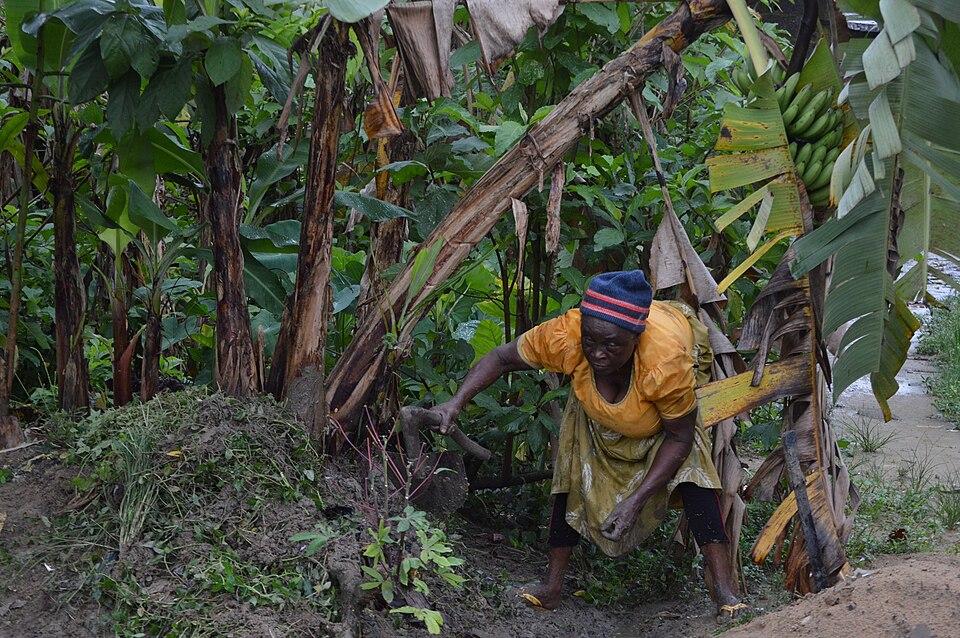
A farmer in Cameroon. Photo by Mekem Z. Prosper via wikimedia commons.
The questionnaire consisted of both a household and individual level section. Face-to-face interviews were conducted in respondents’ homes, while enumerators entered the responses in computer tablets. The modules were : household demographics, asset holdings, expenditure, household food consumption, and agricultural production (types of crops produced, the quantity harvested, the quantity sold, and unit prices etc).
During the face-to-face interview with women of reproductive age, the team focused on their food consumption. This module was particularly tailored for the types of food common in the area and took into consideration the context-specificity in order to properly capture women’s diets.
Measuring women’s diets
They employ minimum dietary diversity for women (MDD), a validated measure of women’s diets in low and middle-income countries. The measure involves ten food groups: grains, white roots and tubers, and plantains; pulses (beans, peas, and lentils); nuts and seeds; milk and milk products; meat, poultry, and fish; eggs; dark green leafy vegetables; other vitamin A–rich fruits and vegetables; other vegetables; and other fruits.
The consumption of more of these food groups is argued to provide essential macro and micro-nutrients to women of reproductive age. The MDD is generally defined as dummy, which takes a value of 1 if a woman consumes at least five of these food groups and zero otherwise.
“However, this approach could not be used since the number of women who consume at least five food groups in our sample is relatively small,” Francis Ebai Ndip acknowledged. “To this end, I use the continuous version, which is the count of the number of food groups consumed over a 24 h recall period. Other studies have also used this approach. A value of 1 is assigned if a woman consumes a food group and zero otherwise.”
The researcher focused only on agricultural income from crops and did not consider livestock since only a few households produce livestock.
On average, women consume two food groups, which is relatively low
However, it is similar to those reported by other studies in different countries, the study highlighted. This low value could also be because the data was collected just before the start of the harvest season, where households may have harvested and sold very little of their production, Ndip added.
The scientist also found that on average, households commercialize about 66 % of their production.
The results suggest that commercialization is positively associated with women’s diets
Specifically a unit increase in commercialization increases women’s diets by 0.514. This represents a 25 % increase relative to the mean dietary score, which is a “relatively large increase”. This implies that a unit increase in commercialization leads to the consumption of an additional 0.514 (approximately 1) food group.

The MDD indicators considers the consumption of at least 5 out of the ten food groups as threshold for healthy diets and meeting the dietary requirements. “With a sample mean of over two food groups, the consumption of an additional food group implies that women can consume up to three food groups and move closer to this threshold, meeting their dietary needs,” the investigation noted.
Nuts, seeds, vegetables
While most of the coefficients are positive, only the coefficients of nuts and seeds; other Vitamin A fruits, and other vegetables are “statistically significant”.
“Commercialization increases the likelihood of consuming nuts and seeds by 18.5 percentage points,” the analysis found. “It also increases the likelihood of consuming other Vitamin A fruits and other vegetables by 14.1 and 14.3 percentage points, respectively.” Fruits, especially vitamin A fruits and vegetables are important sources of micro-nutrients to women.
Commercialization is positively associated with the number of crops cultivated
Specifically, a unit increase in commercialization is associated with the cultivation of an additional crop. “This increase in the number of crops produced may increase household own-food production, leading to better diets for women,” Francis Ebai Ndip wrote.
“This is particularly important for women, because they may also have some control over these crops, especially if they are all food crops. The study area is also unique in that there are no distinct food and cash crops along gender lines.”
More importantly, the results also suggest that commercialization is positively associated with crop income. This income may give households economic access to diverse food types improving women’s diets.
Josiane Kouagheu
Banner image: a farmer in Cameroon. Photo by HnKamwa via wikimedia commons.